Robert Kusmirowski
8 November 2008 - 28 February 2009
pictures


At the end of the exhibition a limited edition LP will be produced of music by Robert Kusmirowski
Opening 9 p.m. to midnight, Saturday 8 November 2008
UHER.C is the first one-man show of work by the young polish artist Robert Kusmirowski. It opens at Guido Costa Projects in via Mazzini 24, from 9 p.m. to midnight on Saturday 8th November 2008.
Kusmirowski’s sophisticated and imaginative mind, coupled with his mind-boggling skills and a mastering of pictorial and sculptural techniques, quickly helped establish him as one of the key artists of his generation and earned him immediate recognition at an international level. A master of fakes and the construction of dreamlike parallel worlds, the key to his poetic oeuvre lies in temporal paradoxes, where past, present and future coagulate in dramatic, suspended atmospheres, riddled with nostalgia.
Mechanics and electronics are the ideal borders of artistic experimentation. Here they serve as symbols of a broader reflection on 20th century European history: wars, deportation, atomic experiments and profound political transformation.
From this point of view, Lublin, the birthplace of Robert Kusmirowski, is a perfect cultural laboratory, a melting pot where centuries of culture, ranging from Kabbalah to real socialism, have deposited and been churned over by an acute nationalist, cosmopolitan, melancholic polish spirit that pushes towards irony and the great challenges, a stone’s throw from the impossible.
The thrill inherent in fakes, which runs through and brands almost the whole artistic production of Kusmirowski, grows in mystic tension (I am God), and hurtles into abysses of arrogance (I am better than God), but also communicates profound pietas towards those little things left behind in the backwash of progress.
This is Kusmirowski’s expressive universe: places and machines with a highly symbolic, non-functional machines halfway between those of Raymond Roussel and Alfred Jarry, but certainly more real than real.
Such is the case with DATAmatic 880 (currently on show at the Fondazione Sandretto Re Rebaudengo), a proto-computer that has until now never seen the light of day in this form, an astral twin of UHER.C, both of which share years (1960 circa). Both were also the fruit of a world devoted to as if: communism realised in a sole country, the fourth and fifth Reich, and the Great Poland.
Whoever thinks that beauty may have to make a sad exit from the scene after paying the price for this fatal exuberance of the possible would be wrong: beauty is no mute servant here or an arid guest made of stone at the banquet of realised reason – not at all.
The work of Robert Kusmirowski is also beautiful.
Their cutting edge is beauty, whether the work be a numerical counting machine, a century-old polish Wolberg bicycle, or a moss-eaten tombstone. The work of Kusmirowski is beautiful, very beautiful and very ambiguous, sanctified by the context in which it is displayed, where a simple pedestal, a frame, or a nameplate can increase or completely cancel the hallowed value of the object.
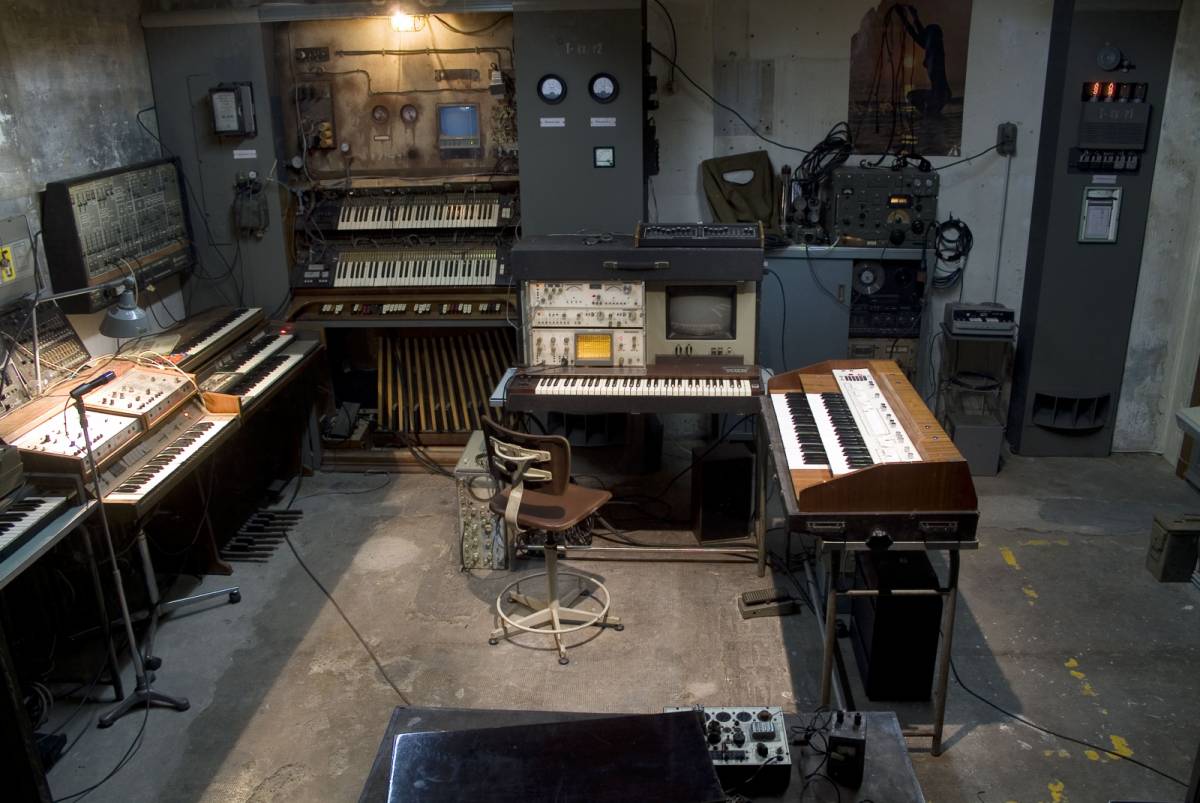
UHER.C, which was especially conceived by Robert Kusmirowski for the via Mazzini space, was created by adhering to a stringent creative path. It is the latest in a family of work that find themselves comfortably at home in the exacting analogous world: we are now in a perfect state of balance between what is and what has been, lapping the stores of the digital era, while staring out dumbfounded towards the future that has been but which no longer appears to many as glossy.
The day after DATAmatic 880 recounted us its binary workings, what could be a better testing ground for such disorientation than a recording studio?
This could be November 1971, but also a summer day in 1967, in the company of Laura Spiegel; that could also be Hawkwind at the mixing desk, or a youthful Brian Eno in a raging hormonal storm, more drag-queen that sculptor of sound than those we get nowadays.
Or, it could be none of all that.
These are machines that simply talk to each other and only about each other.
UHER.C gets its name for phonetic, geographic and historical reasons (respectively Hertz; UHER a mountain region in the environs of Lubin; and Mr UHER.C, a celebrated researcher into the physics of sound).
It is an extraordinary sculpture with a thousand souls, keyboard, oscillators, microphones, amplifiers, recording devices, cables, mysterious objects, pure inventions, sounds, voices and lights. It is a living sculpture that now and again unplugs one of its souls, caged in its circuits for decades, or it gives a voice to other souls born especially for the occasion. Kusmirowski is both the father and slave of UHER.C, at once squashed by the monolithic power of its technology and seduced by its complexity.
UHER.C is a classical, archaic sculpture that has gone berserk: it is both the nightmarish and joyous side of machine.
UHER.C will spark up on the night of Saturday 8th November 2008 and continue to crackle until 28th February 2009, every day from Monday to Saturday during the gallery opening hours.
Yet another chapter in the investigation into the limits of contemporary sculpture that has seen the likes of key players over the years such as Paul Etienne Lincoln, Martin Kersels, Paul Fryer and Diego Scroppo.
* * * * *
Robert Kusmirowski (1973, Lublin, Poland) is one of the most representative figures on the Polish art scene. He has exhibited in museums and public institutions all over the world (Bonnier Konsthall, Stockholm; Museum Folkwang, Essen; Wyspa Institute of Art, Gdansk; Migros Museum, Zurich; ZKM, Karlsruhe; Kunsthalle, Wien; Centre of Contemporary Art, Warsaw; Barbican Centre, London; Kunstverein, Hamburg; Van Abbemuseum, Antwerp; PS1, New York; New Museum, New York; Royal Academy, London). He also took part in the 4th Berlin Biennal, the 2nd Turin Triennal and the Folkston Triennal. He is represented by the following galleries: Foksal Gallery Foundation in Warsaw, Johnen-Schottle in Koln and Berlin, and Guido Costa Projects in Torino.