Boris Mikhailov
6 November 2011 - 31 January 2012
pictures


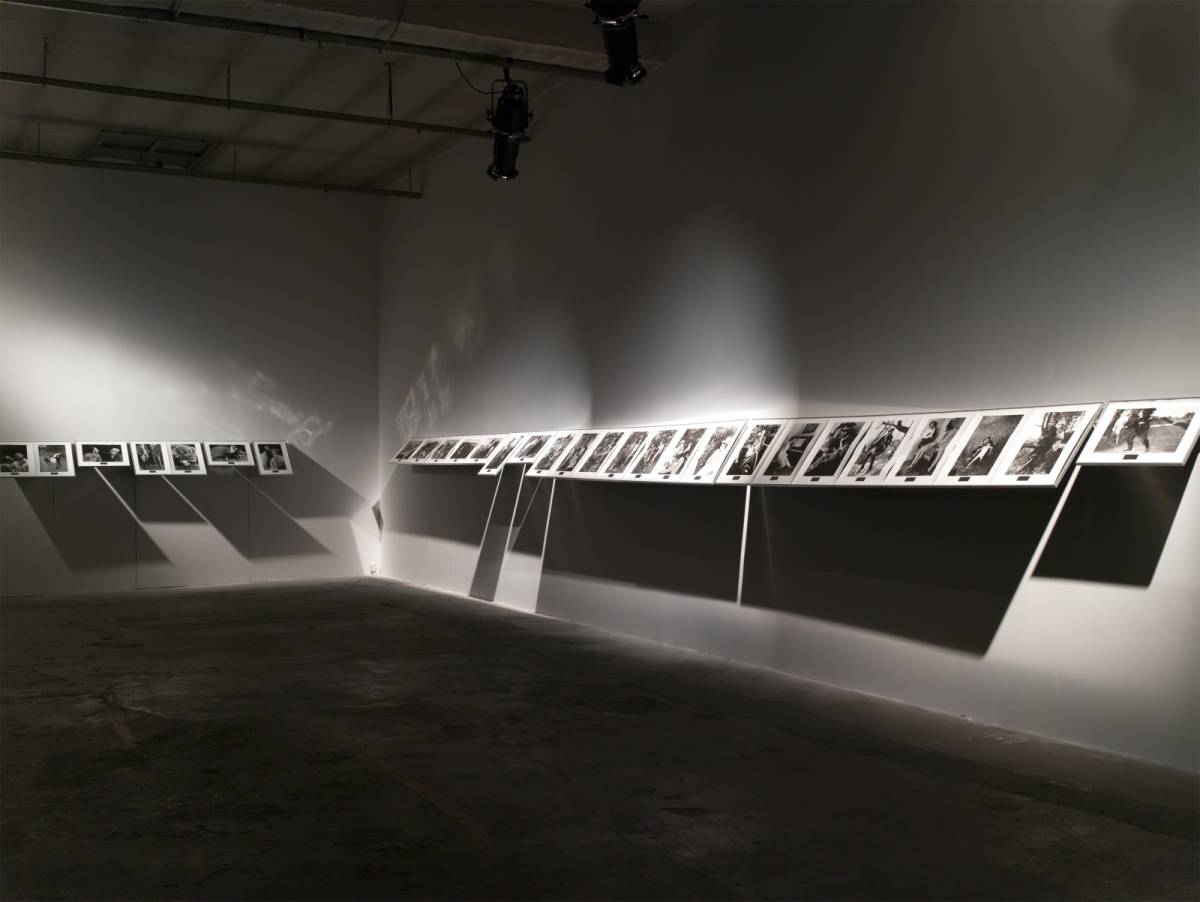
On Saturday 5 November Guido Costs Projects opens “If I were a German…”, an exhibition of works by Boris Mikhailov. The opening will take place from 9 to midnight in the gallery space in via Mazzini, 24.
Produced in Kharkov in the Ukraine in 1994, with the grateful collaboration of Vita Mikhailov, Sergei Solonski and Sergei Bratkov, “If I were a German…” is a significant body of work from artist’s long career, both from a thematic and formal perspective.
"If I Were a German…" gives us a foretaste of many of the themes that the artist would develop in his most famous work of the late 90s, Case History. This series in question here has a clearly narrative almost theatrical structure, despite the lurking presence of extremely theoretical considerations, such as victim-torturer and master-servant. The tone is at once grotesque and at times bluntly symbolic as if the different images in the cycle were seeking to represent the dialectics of power in all its tonalities. These pieces are brief reflections on the injures sustained during a recent post-war past, with a pinch of black humour from a Ukrainian Jew as he ponders, engrossed the idea of Germany, a symbol of power and domination.
Alongside the artist, his wife also stars in this series, as do two old friends and a Nazi uniform. Using these elements the artist provides us with a shifting perspective of stereotypes of the struggle between peoples and the disasters of war. They become in turn a sort of macabre dance where the roles of victim and torturer gradually switch, thus bringing into question the idea of genre and identity, eventually providing a setting for the victim to celebrate her own sacrifice.
It is not by chance that many of Mikhailov’s shots recall archaic rituals closely resembling religious rites, into which he has stirred irony and cynicism. In these pieces Boris Mikhailov takes a break from psychological references and the idea of the past, preferring to relocate the tragedy of war within the immanence of human destiny and the idea of nature, where the drama of all peoples precipitates and is resolved.
"If I Were a German…" is probably one of the pieces most pregnant with meaning and definitely one of the most complex and reflective. Not surprisingly this cycle of work is one of his less well known, having rarely been exhibited in public.
In a recent interview Mikhailov asks, “What is guilt?” Referring to this work, he says, “It’s not possible attribute guilt to a whole population… time moves forwards, everything moves on…”
Time. Time moves on and reshuffles the pack. These photos portray Mikhailov both as Nazi and Jew, Russian and German, father and son, pure and impure. He has almost left behind the historical perspectives in his earlier work on the fall and transformation of the Soviet Empire which spans Red Series (produced in the 60s and 70s), and By the Ground and At Dusk (1991 to 1993). This series is a prelude to the cosmic melancholy of Case History (1997-98).
It is therefore great pleasure that we present this very important series of work by Boris Mikhailov, one of the most influential artists of his generation and one of the few great innovators in the world of contemporary photography.
The exhibition will remain open to the public during gallery opening times until January 2012.
* * * * *
Boris Mikhailov (Kharkov, Ukraine, 1938) is one of the most renowned and important photographers on the international scene. His artistic career spans nearly half a century, and he is a essential reference point for two generations of artists from the ex-Soviet Union and many contemporary photographers. He has had numerous exhibitions in museums and public institutions, including recent one-man shows at the Tate in London, the Stedelijk Museum in Amsterdam and the MoMa in New York. His work is held in the most important collections around the world, from Palazzo Grassi to the Saatchi collection. In 2000, he was awarded the prestigious Hasselblad Prize. Twenty monographies of his work have been printed. This is the third exhibition in Turin with Guido Costa Projects.