Peter Friedl
24 April - 24 June 2021
immagini 


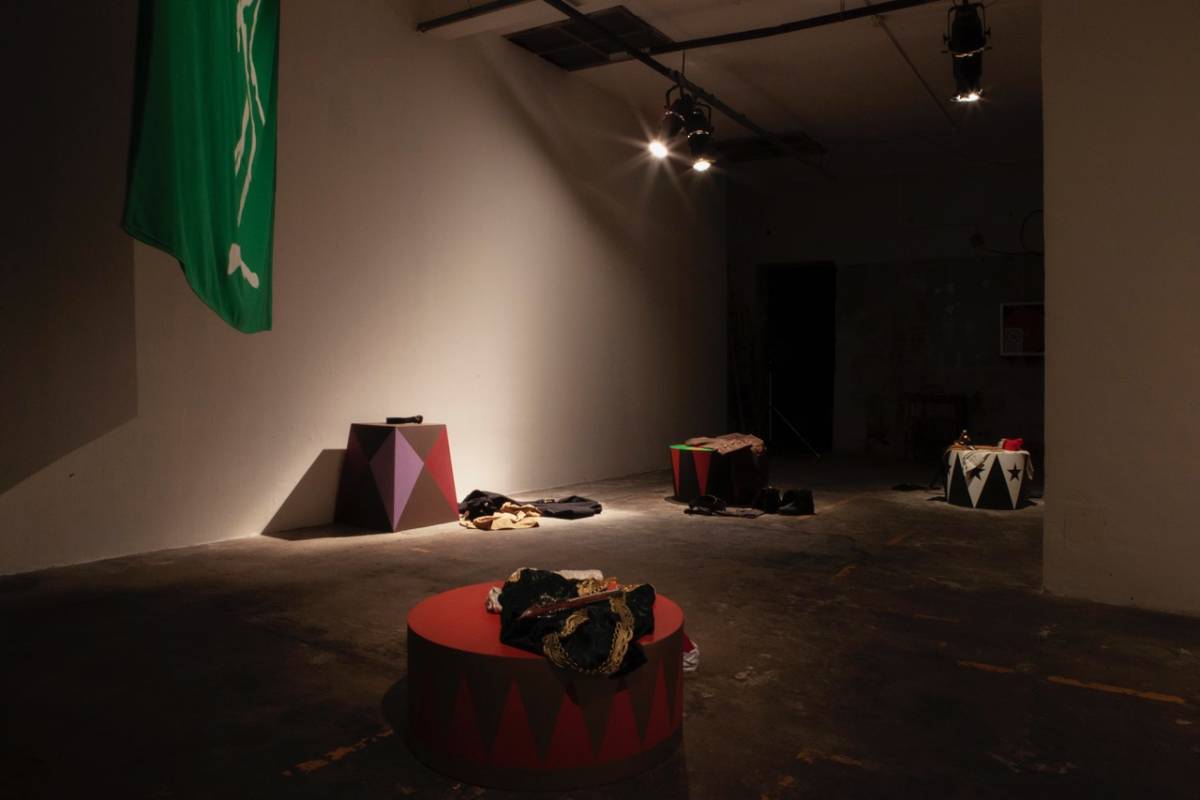
Traditionally associated with the Golden Age of Piracy between the 1650s and the 1730s, no prey, no pay is a maxim which delineates the strict relationship between plundering and pay that ruled on pirate ships. Coined to motivate action, this short socio-economic precept also functions as a sort of moral code. Peter Friedl’s new exhibition at Guido Costa Projects illustrates this concept by way of an idiosyncratic cast of distinctive fringe characters whose compelling biographies, poised between reality and legend, embody this equivalence between risk and remuneration. To each of these characters Friedl has dedicated a pedestal, such as those used in circuses, and around each pedestal lies a pirate costume in disarray. The pedestals are sculptures, but each is also a “Speaker’s Corner”, a stage, and a symbolic place waiting to be activated.
The exhibition is a further element in that ongoing fresco dedicated to theater which Peter Friedl has been working on for many years. It is a sort of mise-en-scène, populated with stories, memories and projections that await the arrival of the characters. For example, Benjamin Lay (1682-1759), known as “the irrepressible prophet”. Lay was a Quaker, a dwarf and a merchant on the island of Barbados, who went on to become a pilgrim, polemicist, vegetarian, and dramatic and fierce opponent of slavery. Or Rafael Padilla (stage name “Chocolat”). Padilla was an Afro-Cuban by birth who became a famous clown in Paris at the beginning of the 20th century, one of the first black entertainers to tread the boards in Europe’s most prestigious theaters. Or, another character, Joice Heth (ca.1756-1836), the elderly African-American slave, passed off by P.T. Barnum as George Washington’s 161-year-old nurse whose dead body was later subjected to a public autopsy. Beyond such historical realities we also find more legendary figures such as The Dragon Lady, a stereotype of the oriental femme fatale, immortalized by Milton Caniff in the successful comic strip Terry and the Pirates (1934) as well as in many Hollywood films, including Daughter of the Dragon starring Anna May Wong and Kill Bill by Quentin Tarantino. Friedl also references the opera Polly by John Gay (1685-1732), a sequel to his infamous The Beggar’s Opera set in the West Indies; and the pirate Black Caesar, a genuinely mysterious and subversive figure, active in the Florida Keys at the beginning of the 18th century said to have been on the payroll of the buccaneer Blackbeard.
Peter Friedl has masterfully orchestrated this polyphony of voices, all gathered beneath a large apocryphal Jolly Roger, entitled King Death, which serves as a backdrop to the exhibition. No prey, no pay is an empty stage waiting to come to life, distilled into a few meditated and essential traits, rich in lore, conjecture, and precise counterpoints. It is a complex scenic machine that transforms the overly easy picturesqueness of non-common biographies into reflections on themes of great political relevance, from image criticism to Black Studies.
The installation was first created in 2019 for the 14th Sharjah Biennial in the United Arab Emirates, and opened, on that occasion, with a performance by Johnathan Lee Iverson, the last ringmaster of the Ringling Brothers, Barnum & Bailey Circus (closed down in 2017).