Peter Friedl
27 May - 27 July 2011
pictures 


A solo show of new work by Peter Friedl opens at Guido Costa Projects in via Mazzini 24 at 6 p.m. on Friday, 27 May.
These two pieces by Friedl, one of the most complex and sophisticated artists of his generation, provide us with a keen insight into the boundaries between micro and macropolitics.
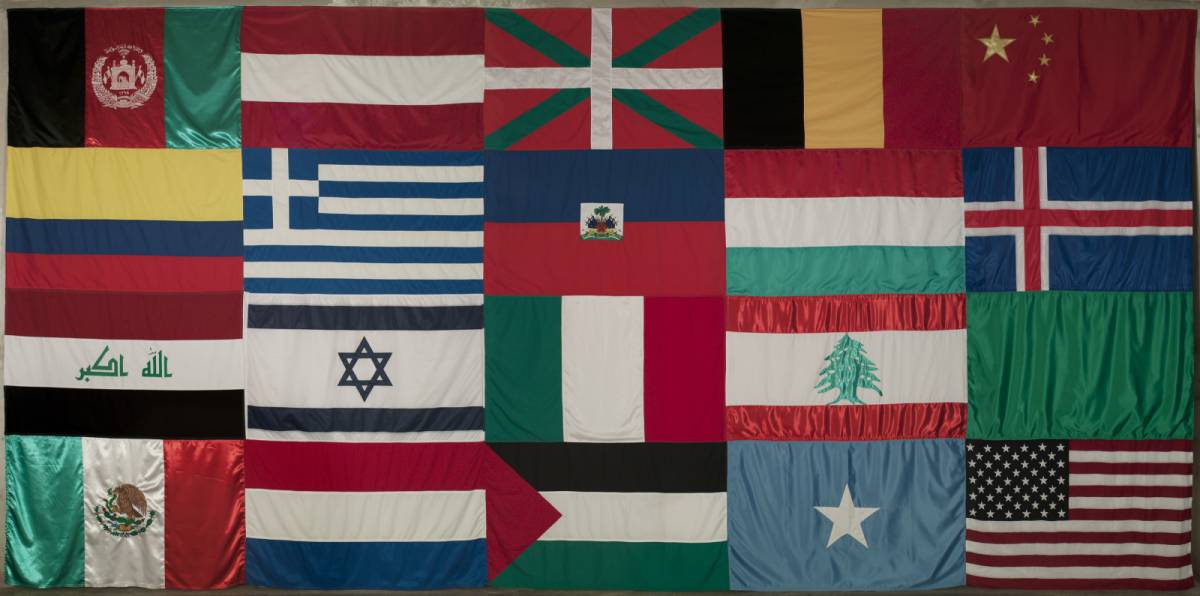
The first piece, Failed States, is a large picture comprising 20 national flags, which explores failure and the ambiguity of the parameters we are used to adopting when passing judgements. It refers to the infamous “Failed States Index" published each year in collaboration with Foreign Policy by The Fund for Peace—a privately funded US organization compiling not only data from the economic sector but clearly following ideological patterns.
Arranged in alphabetical order, these twenty states, including some that do not exist yet, are a symbol of a further failure, which involves those same parameters used for their selection.
In keeping with the logic of unmasking, which has always been the driving force behind his artistic production, whether used to reveal the truthfulness of images or the presumed extraterritorial nature of aesthetics, Peter Friedl offers us a clear example of ideological and formal deconstruction, represented in the form of the flag of flags. Friedl’s choice of subject matter brings into play arbitrary aesthetics, where the actual choice of using certain flags raises questions concerning the concept of adequate criteria.
The same spirit, somewhat subversive, is at the heart of the second piece in the show. Here, we once again find wit and an analysis of micropolitics on the same scales. However, it's about a different sort of failure, or rather, an involuntary Freudian lapsus.
A large white neon installation spells out a handwritten sentence from Antonio Gramsci's Quaderni dal Carcere (prison notebooks) where the author attempted to translate a passage from Magnificence, a play by the eccentric English poet and humanist John Skelton. Magnificence is a “morality play," with allegorical figures in which good prevails over evil. In verse 1040 Fancy, one of the characters, says: “I can find fantasies where none is.” Gramsci translates the sentence incorrectly: “Io posso trovare fantasie dove non c'e' nessuno.” (I can find fantasies where there is no one). The translation is wrong but what is important is that we find ourselves facing a new collapse between micro- and macropolitics. It is through this narrow and unwanted crack that desire, or to be more emphatic, the weight of suppression creeps in.
Faithful to his essential style and method of slowly distilling meaning, Peter Friedl provides us with this artwork—imperfection’s perfect surface—with a highly stimulating and elegant essay on conceptual analysis as an art form, confirming his position as one of the most profound artists on the international scene.
* * * * *
Peter Friedl was born in Austria in 1960; he lives and works in Berlin. His artistic practice—often heterogeneous in style and media—emphasises the friction between aesthetics and political awareness in their respective narrative contexts. His work explores different conditions and fields of representation, employing strategies of dislocation, editing and over-exposure. He has exhibited internationally in numerous public and private spaces. His work was included in Documenta X and 12, the 48th Venice Biennial, the 2004 Berlin Biennial and the 2006 Seville Biennial, and those of Gwangju and Sao Paolo in 2008, Tirana in 2009 and at Manifesta 7. In 2006 and 2007, a retrospective of his work travelled from the MACBA in Barcelona to the Miami Art Museum and the Musée d'Art Contemporain in Marseille from. This is his first exhibition at Guido Costa Projects.